Sunday, 18 March 2018

Introducing Team African Wild Cat

The morning game drive is just as fruitful as last night’s and we see bat-eared foxes and the enormous springbok herd before spotting four cheetah.


Unusually, it is a coalition of 4 males and we are first on the scene so we have them to ourselves for a while. A springbok has seem them too, and keeps edging forward as if to get close enough to be sure of what he has seen, before running off to join the herd.


There is a jackal tailing the cheetah, no doubt hoping for handouts; we watch the cheetah as they scent-mark trees and roll in the sand. Vehicles begin to arrive, including Carol’s group. We follow the cheetah as they walk languorously through the landscape, before crossing the road and disappearing over the top of a dune. Sue reveals the design on today’s top – it’s a cheetah!


We leave for a waterhole and on the way see oryx, various raptors and the wildebeest again. The wind is beginning to gust strongly and when we return to camp Mike is concerned that it will blow down the gazebos. Cooking is hampered by having to tether the gazebo so breakfast is rather late.

Today’s photography lesson is editing with Lightroom and I’m keen to learn but feeling the effects of the heat, a few nights of sleep deprivation and some very early mornings. I keep falling asleep so I’m relieved that Denise is filming it as I will need to recap later. Later, we walk across the border to Namibia but the ranger’s office has told us that the shop is closed because it’s Sunday so we don’t go any further than the immigration office. The staff there seem bemused that we don’t want to enter the country. We pick up some leaflets and I examine a box of what looks like cartons of sweets but turns out to be complimentary condoms.


The evening game drive is extremely eventful. The wind has dropped but there’s a storm approaching, bringing dramatic clouds and unusual light. We see some giraffe, with their necks comically emerging from bushes, the springbok herd and a bird with a pink breast and blue tail, then the four cheetahs from the morning drive with the jackal still on their tail. Louise’s sunglasses blow off her head as we’re driving along and we have to go back to retrieve them. We see more giraffe and oryx, dramatically silhouetted on the top of red sand dunes. There are more bat eared foxes and then some oryx fighting; a giraffe crosses the road with a stately gait - the light is beginning to go. Half a rainbow appears and it begins to rain a little.


Then we see something sitting in the road ahead of our vehicle – it’s an African Wild Cat! It walks slowly off the road and climbs a small bush, then comes down again and walks in front of the truck. I’m at the back and can’t really see it, but I realise that it is looking off to the left and when I follow its gaze there’s another wild cat. It joins the first and they cross over to the right of us, rubbing noses and behaving exactly like domestic cats, before melting into the undergrowth. Even Bobby-Jo is excited, this is a very rare sighting! Finally we have a team name - we are Team African Wild Cat.

The drive still has more to give and in the torchlight we see scrub hares and bat eared foxes on the way back to camp, then two more African Wild Cats, although these are less obliging. Back at camp, Mike tells us that a genet tried to steal the pork chops he was preparing for dinner and shows us where to find it in the lower branches of a tree. Sue and Ray have also seen bat eared foxes in the campsite.

During the night I hear a sound that I think might be a lion roaring – it’s confirmed when I hear Bobby-Jo say “lion” from her tent tent. I think about waking Denise but can’t be sure she would want her sleep disturbed, or that the lion will roar again after I wake her.

Saturday, 17 March 2018

To Mata Mata

I wake up refreshed, having had the best night’s sleep since we left Upington. Our 6am game drive is in a bigger truck and although there are two couples with us we all have a window seat. It’s very noisy though and game are more nervous of it; it also can’t reach the lion kill in the time allowed so we have to settle for jackals.


We also find some ostriches having a dirt bath, more jackals, some wild meerkats and red hartebeest. On the way back we find two male lions close to the gate.


We have breakfast in the restaurant, leaving Mike free to get on with packing up camp. By the time we get back he’s packed all the tents and we help stow everything in the vehicle and trailer, leaving just after 11am. The drive to Mata Mata takes us through the park so we have the opportunity for game viewing on the way. We find a group of secretary birds and two male lions, one apparently much older and with a damaged eye.


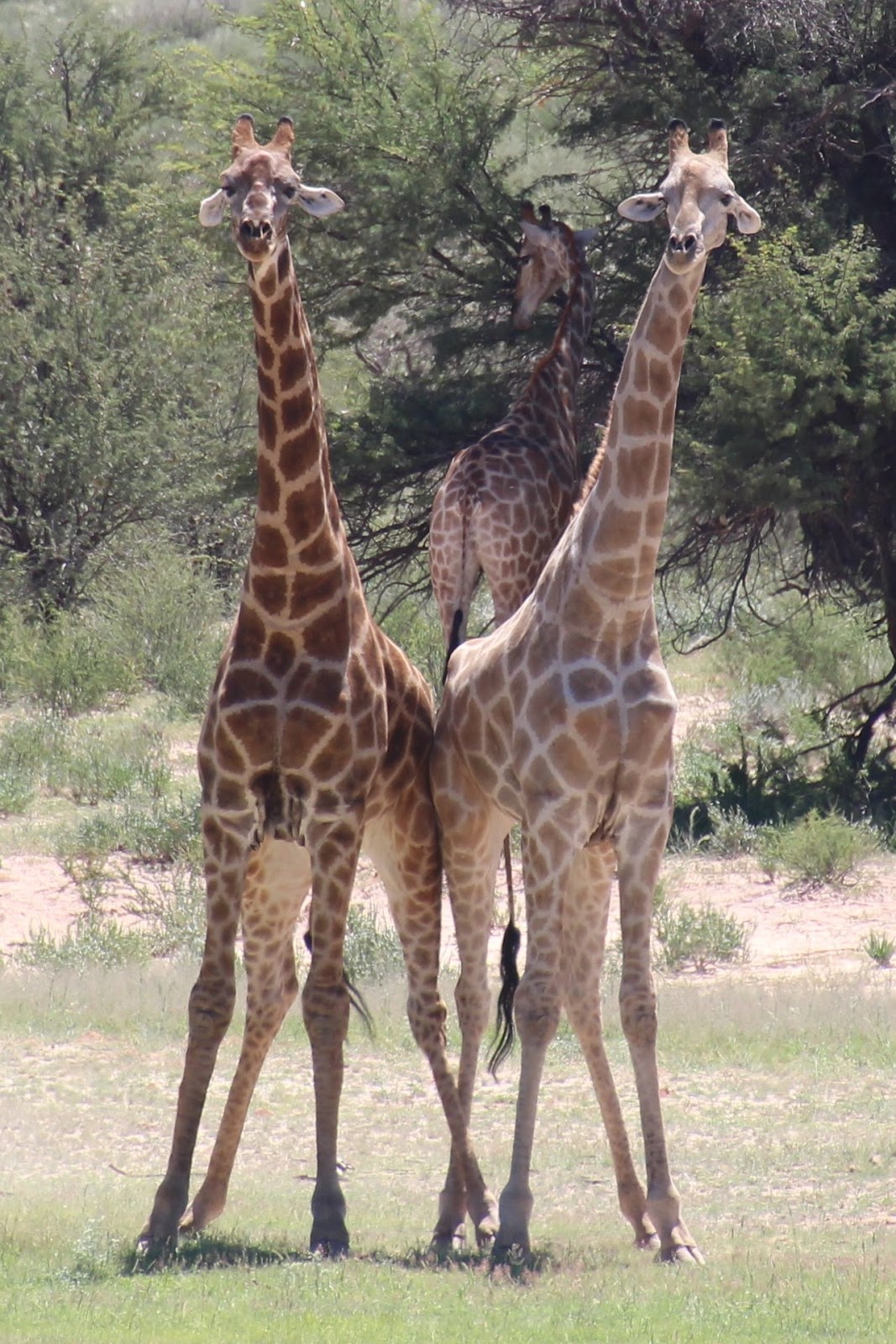
Further on we encounter a large herd of giraffe; two of the males are “necking”. One is much paler than the other and they walk side by side in a tight circle, stopping to bash each other’s neck with their own. It looks so graceful considering that they’re fighting.


When we arrive at Mata Mata the campsite is quite full, but we find a shady spot near the fence with a clear view of the park. We set up camp and go to check out the shop; I buy a sausage roll to share with Denise and a can of dry lemon – my new favourite drink, like bitter lemon with more quinine. We’re much more remote here but the campsite is well equipped with showers and toilets, a scullery and drying area. There’s a bird hide, too.


We are right on the border with Namibia and Bobby-Jo tells us we can walk to a small shop on the Namibian side. There’s working wifi here, too, but the signal doesn’t extend far beyond the ranger’s office. None of us has had a phone signal since leaving Twee Rivieren.

Just before 6 we meet the ranger, Andrei, who will take us on our game drives here - he is a San bushman, one the indigenous people whose language includes distinctive clicks. The game drives at Twee Riviern tended to stick to a single dirt road that followed the line of a dry river but here there is a greater choice of routes. We soon turn off the main road onto a track that runs along the dry river bed through a landscape that is weirdly reminiscent of British parkland. The grass and the shape of the trees are quite familiar, although the light sandy soil is not. Neither are the massive skeletons of dead trees that seem to die from the inside out, collapsing outwards to resemble the exoskeletons of enormous many-legged spiders.

We see some wildebeest and an enormous herd of springbok, including some who are “pronking” – a distinctive bouncing gait where all four feet leave the ground at once. We find a Kori Bustard, the largest bird capable of flight - birdlife is very plentiful here and we also spot a southern white faced owl, a spotted eagle owl, red necked falcons and an immature pale chanting goshawk. As night falls we see giraffe silhouetted against the sky, bat eared foxes and a rufous-cheeked nightjar. Later, a scrub hare and a porcupine and then a grazing giraffe who, despite his size, blends in to the vegetation so that we don’t notice him until we are a couple of metres away.

When we get back to camp, Mike has cooked us smoked roast chicken with potatoes, veg and a salad. We go to the hide after dinner but there’s nothing much to see.

Friday, 16 March 2018

Mostly lion

We’re up at 5 for a hot drink and a rusk so as to be in time for a 6am game drive. We have Hanel’s vehicle to ourselves this time. We have agreed to return to the place where we saw the cheetah and her cub, but along the way we see jackals, secretary birds and wildebeest with calves.
Then we’re stopped by a passing vehicle and told that a male lion has killed an oryx. We find him a little way past where we found the cheetahs, resting with a full belly. The oryx has been stowed beneath a tree and a pair of jackals watch at a distance, looking for an opportunity to scavenge. We spend some time here, enjoying the golden morning light.


On the way back to the gate we see some live oryx, more wildebeest and springbok, including a solitary springbok sitting in the dry riverbed, a pale chanting goshawk and some ostrich with chicks. We also find the cheetah and her cub.


In the middle of the day, Mike takes us out on an additional game drive, in the combi. We return to spend some more time with the lion and his kill, and on the way back we see some springbok, wildebeest and oryx. The cheetah and her cub are resting beneath a tree. 


When we get back, Bobby-Jo teaches us how to clean our cameras while we eat some wraps to keep us going until dinner time; birds and squirrels scrabble for crumbs around our feet.

Our evening game drive heads straight for the lion, stopping briefly when Hanel thinks she may have run over a cape cobra. We reverse to look for signs and find only the wavy track it has made in the dirt road – it clearly got away. We spend “golden hour” with the lion, which is still accompanied (at a safe distance) by two jackals; they seem to be eating the blood spilled when he made the kill. We see more jackals on the way back to camp, as well as two male cheetah lying beneath a tree and both bat-eared and cape foxes.


Dinner tonight is a beef casserole, cooked in pot-bellied pot over charcoal.

Thursday, 15 March 2018

To the Kgaligadi

My alarm goes off and I turn on the light; immediately a bat begins to fly in frantic circles around the rondavel – he’s obviously alarmed by the light and I don’t think his presence will be conducive to packing. I turn off the light and the flying stops – now I can hear him exchanging chirps with another bat. Unsure what to do, I leave the top of the stable door open and go to the kitchen for a coffee, leaving the top of the stable door open. By the time I return he has either gone to sleep or left and I pack without interruption.

Before long the kitchen equipment is back in the trailer, along with our luggage, and we’re ready to leave by 8am. At this point I realise there is a wifi signal but it’s too late to do anything other than post a single what’s app message home. My phone hasn’t had 3G since soon after we left Upington and doesn’t seem to think H+ is good enough for sending photos even when the signal appears strong. We swing by the HQ to say goodbye and thanks to the team and set off along the dirt road towards the Kgalagadi Transfrontier Park. We've been having fun with the pronunciation of our destination - known as the Kalahari outside Africa, the proper pronunciation includes a gutteral sound like the "ll" at the beginning of Welsh words and none of us can quite get the hang of it. 

It’s notable how different the landscape is here compared to East Africa – there are no villages or settlements along the road, just endless ranches and sometimes the only visible sign of those is a grand entrance gate and a cattle pen. We see no humans and little wildlife; we stop to photograph a massive sociable weaver bird nest and Mike has to avoid running over tiny tortoises on the dirt road.


After a couple of hours we spot a sign for a place called Askham. It’s pretty small but it has a fuel station, a trading post and – most exciting of all! – a coffee shop. We stop for coffees and some souvenirs, use the rest rooms and read the small display about the origins of the place, which was apparently named when a Scottish settler replied “ask him” to somebody who inquired about the name of the place. I buy a lipstick and lipsalve that benefits a local social welfare project, and some home-made fudge to eat with our coffees.

We reach the transfrontier park in good time, arriving at a gate which offers entry to the park via either South Africa or Botswana. We’re camping on the South African side, at a campsite called Twee Rivieren (two rivers – although both have been dry for decades!).


We unload the combi, set up our tents and two gazebos which will be our kitchen and dining area, then go to explore. There are excellent toilets and showers, even a hair drying area and washing up room; just up the hill is a shop, a restaurant and a small swimming pool. The shop provides an ice cold beer, very welcome after setting up camp in the heat. It also sells wifi vouchers but unfortunately the service isn’t working currently. Denise, Louise, Ray and I cool off in the pool, while Karen defends our bags from some enormous millipedes.

Just before 6 we go to meet our guide, Hanel, who will be taking us on four game drives. The vehicle is brand new, accommodating 10 passengers in tiered seats with almost entirely open sides and a canvas roof. We’re sharing with a South African couple this evening. We have about an hour before night falls and the light already has a golden tinge. The first thing we see is a group of 3 jackals, including one behaving extremely submissively, then a bright green bird I can’t identify. Oryx and springbok, then somebody spots a lioness silhouetted on the top of a dune and we follow her down where she meets another female and the two of them stroll along the side of the track before crossing the road and disappearing into the bush. Later we see both bat eared and cape foxes, and catch a glimpse of an African Wild Cat.

We have an unexpected human encounter, when Bobby-Jo recognises a fellow wildlife photographer called Carol who is also leading a tour group. It seems she will be at Mata Mata at the same time as us, too. After dark we use torches to highlight the eyes of animals, concentrating on the carnivores, as we head back towards the campsite. We find a cheetah and her cub on the side of the sand dune but they seem to have settled down for the night and are too far away to see clearly. We leave them in peace and continue our journey; we see a spring hare and a scrub hare on the way to the gate.

Back at the campsite, Mike has cooked us a braai.

Wednesday, 14 March 2018

Meerkats and Tims

I lie in until 5.30 this morning, as I have been assigned to the Van Helsing group which is right next to the farmhouse. I grab a coffee and a rusk to dip in it, then Doug comes to pick us up and drives us a short distance to the burrow where the meerkats spent the night. This is a large group and it takes a while for them all to emerge from the burrow. There is a lot of play-fighting among the younger meerkats, while others – including a pregnant female – stand and soak up the warmth from the morning sun. Doug sets to work weighing them, but they are not especially co-operative.


Suddenly they are off and foraging, heading towards the road. There are wooden ladders on the high fence on our side of the road and the lower one opposite, and we clamber over to follow them. On the other side of the road delicate pink lilies grow close to the ground in between the trees and the landscape looks quite magical, like the forest in the movie Avatar. A crimson-breasted shrike provides a splash of red against the pastel shades. 


The meerkats use the fallen trunks of trees as sentry positions and don’t mind at all when we approach to photograph them. If we sit still they will come very close, paying no attention to us as they forage for insects. They are quite spread out so it’s possible to get between the leaders and the laggards and choose a spot that the rest of the group will pass. I find a fallen tree that looks like a prime sentry spot and settle at the lower end to wait for the meerkats. As expected, a sentry takes up his position at the opposite end to me and stays for quite some time, surveying the landscape in search of threats. A small lizard emerges from a hole in the trunk and briefly suns itself.

Taking a break from foraging, some of the meerkats begin to play-fight while others “pancake” on the sandy ground – spreading themselves out like spatchcock chickens on the grill at Nandos. Because the meerkats were slow to emerge, Doug radios HQ to let them know he won’t be taking their weights until 11am. By 10.30 the meerkats have resumed foraging and we decide to walk back to the farmhouse early. It’s been an amazing morning, with the meerkats displaying various different types of behaviour in a stunning landscape. It feels like such a privilege to be in this beautiful, peaceful place and to be able to observe the meerkats behaving naturally, as though we weren’t there.


When we get back, Mike prepares lunch of leftover spaghetti Bolognese accompanied by steak wraps. After brunch Bobby-Jo continues the photography lessons and we learn about focal lengths and apertures, then practice panning as she runs backwards and forwards along the drive. I’m definitely more confident now about switching between different settings on my camera although the pictures I take vary more in quality.

I’m with Sue and Ray again this afternoon, but Bobby-Jo is with another group and Mike is joining us. Alice picks us up, giving Sue the opportunity to give her the promised meerkat top, and we return to where we left the Van Helsing group this morning. They are very scattered, but come running towards Alice before beginning to make their way back to last night’s burrow. A pregnant female starts to dig frantically and we watch her, hoping she’ll find something impressive to eat, like a scorpion. She continues digging until we can see only the tip of her tail, stopping occasionally to look at us quizzically, but she never seems to find anything. Suddenly she stops digging and runs after the others who have mostly crossed the road by now, stopping briefly in sentry pose at the side of the road before scampering across with her tail held high.


The Van Helsing Group is particularly cooperative this evening, both in allowing Alice to weigh them and photogenically. Some groom each other and others play-fight in the golden evening light and we have plenty of opportunity to photograph them before one by one they slip into their burrow. We walk back to the farmhouse to change into clean clothes and Mike drives us over to Tims. We’re first to arrive at Tim’s house which was built for a former manager whose wife insisted that she would only accompany him if he built her a house. He invites us in, introduces us to another Tim who manages the research projects and pours us a “Tim’s” – his name for Pimms, a quintessentially British drink that seems incongruous here. We’re directed to the veranda and settle down to chat. An American woman called Laura arrives – she is a friend of the Kalahari Meerkat Project and receives exclusive access in return for generous donations – then Bobby-Jo and the others. The Tim's flows as smoothly as the conversation, while Sue and I (who are seated nearest to the light) try to evade the attention of countless moths and bugs.

We return to our farmhouse somewhat the worse for wear; Sue goes straight to bed and the rest of us eat dinner first. Tomorrow’s early start could be a struggle …